
Table of Contents
How to Design a Speaker System for Corporate Events in San Francisco
Choosing the right speaker system for a corporate event isn’t just a gear decision — it’s an engineering problem. Get it wrong and your audience is either straining to hear a panelist from the back row, or wincing from reverb bouncing off the walls of a cavernous hotel ballroom. In this guide, Westwave AV’s William Cook sits down with Richard Healy, a veteran A1 engineer based in the San Francisco Bay Area, to break down how professionals approach audio system design for corporate events of every scale.
Start With the Room, Not the Gear
The single most important factor in designing an audio system for any corporate event isn’t the speaker brand or the budget — it’s the physical space. Room size, shape, ceiling height, and acoustic characteristics all drive the decision before a single piece of gear is selected.
As Richard explains it: “Is it a ballroom? Is it a breakout room? You don’t want to over-spec. It’s a cost issue, it’s a power issue, and it might be a physical limitation — what the room can actually have.” Every subsequent choice flows from this foundation.
For corporate AV in San Francisco specifically, you’ll encounter a wide range of venue types — the intimate boardrooms of FiDi hotels, the mid-size ballrooms at Moscone-adjacent properties, and the vast general session spaces used for large tech conferences. Each demands a different approach.
Pro Principle Always size for the minimum that gets the job done, then scale up if the budget, power, and space allow. You can always turn a speaker down — you can’t make a physically inadequate system perform beyond its limits.
The Minimum Starting Point: Why 8-Inch Speakers Are the Floor for Corporate AV
When it comes to speaker size, Richard draws a clear line. For any corporate event, 8-inch speakers are the floor — the smallest cabinet that makes practical sense for real reinforcement work.
“Anything smaller than an eight or ten isn’t going to be any help,” he says. In a room of 35–40 chairs — a typical breakout or boardroom session — a pair of 10-inch or 12-inch cabinets will do the job comfortably. The key insight: because you can always turn down the volume, it’s smarter to have slightly more speaker than you need than to run an undersized system at its limit.
Running cabinets near their maximum output introduces distortion, reduces headroom for unexpected moments (applause, feedback spikes), and forces louder volume levels on the people seated closest to the speakers — destroying the uniformity that should be the primary goal of any reinforcement system.
Point Source vs. Line Array: Choosing the Right Tool
This is the question Westwave AV gets asked most often when scoping a corporate production. The short answer: point source for smaller, more contained spaces; line arrays when the room gets large, wide, or deep enough that a handful of cabinets can’t uniformly cover the audience.
What Line Arrays Actually Do Differently
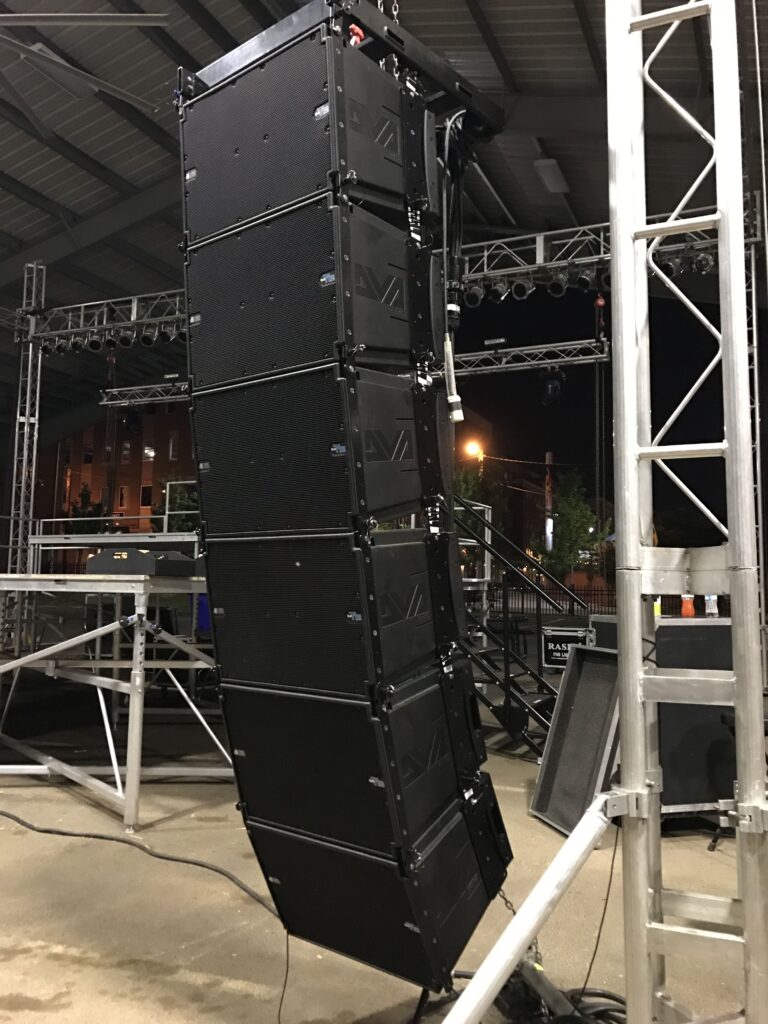
Line arrays aren’t just bigger point source speakers. They behave differently at a physics level. A properly configured line array controls the vertical dispersion of sound, allowing audio to travel further into a room while maintaining consistent SPL (sound pressure level) from the front of the audience to the back. “People in the front of the audience are getting a similar volume as people in the middle or back,” Richard explains.
That consistency — every seat hearing roughly the same thing — is the defining goal for corporate audio. Unlike a concert where some energy and excitement can come from loud, immersive sound, a corporate general session needs the audio rentals to be invisible. Presenters should be clearly heard, not amplified in a way that calls attention to itself.
When Point Source Wins
For spaces under roughly 500 people, point source cabinets are often the right call. They’re faster to deploy, simpler to dial in, and in the right room, can deliver excellent uniformity with strategic placement. Richard highlights the Siva (a relatively newer compact line array hybrid) as a strong middle-ground option for wide rooms: “They’ve got a really wide throw,” making them effective in spaces where you have width to cover but not the ceiling height or rigging infrastructure for a full line array. Workhorses like the QSC K.2 Series remain a go-to point source cabinet for corporate AV across the Bay Area.
“The ultimate goal on these corporate shows is clean, high-quality audio that isn’t distracting for the audience — uniform across the room, regardless of where they’re sitting.”— Richard Healy, A1 Engineer, San Francisco Bay Area
| Factor | Point Source | Line Array |
|---|---|---|
| Ideal audience size | Up to ~500 | 500+ (or complex rooms) |
| Setup speed | Faster | More complex |
| Sound uniformity over distance | Moderate | Excellent |
| Requires rigging/flying | Rarely | Often preferred |
| Works well in reverberant rooms | Yes (at lower SPL) | Depends on config |
| Aesthetics / visual footprint | Visible on stands | Flyable, less obtrusive |
| Cost relative to scale | Lower | Higher |
Room Acoustics: Why Over-Speccing Your PA Can Actually Hurt Sound Quality
One of the most counterintuitive lessons in corporate AV is that more speaker power can make a room sound worse — not better. In highly reverberant spaces (think marble-floored hotel lobbies, ballrooms with hard ceilings, or spaces with a lot of glass), driving a large PA at high SPL creates a wash of echo that makes speech intelligibility almost impossible.
In these situations, Richard recommends a distributed approach: “Smaller point source cabinets placed strategically around the room as delays at a lower volume. You get coverage without screaming loud.” The result is cleaner, more intelligible audio across the room — which is always the priority for corporate speech reinforcement.
The inverse problem is just as real. Two 12-inch cabinets on either side of a stage in a wide, reverberant room will have to be driven loud enough to reach the back — which means the people in the front rows are sitting too close to very loud speakers. Uniformity suffers, fatigue sets in, and the sound becomes the distraction.
Key Principle More speakers at lower volume beats fewer speakers at high volume — especially in rooms with hard, reflective surfaces. Distribute the sound; don’t blast it from a single point.
Placement Is Everything — Point the Speakers at the People
It sounds obvious, but Richard cites speaker placement as the most commonly overlooked variable on corporate shows. “I point the speakers at the people — that’s a big one,” he says. “Focus on where the stage is going to be. Keep the PA in front of the stage, where the audience is going to be. Point the cabinets at the people.”
What this means in practice: tilt your cabinets down toward the audience rather than shooting sound flat into the back wall. Sound hitting a hard flat surface bounces back and creates reflections that muddy intelligibility. Angling speakers downward directs energy toward people and reduces the amount of sound exciting reverberant surfaces.
For larger deployments, measurement tools like SMAART by Rational Acoustics — the industry-standard audio analysis platform — combined with an RTA (real-time analyzer) microphone allow engineers to take readings at multiple points in a room and confirm that coverage is actually uniform, rather than just assuming it is. “That’s why you want to hire a good engineer who does this for a living,” Richard notes. Take a look at our why choose us for more info!
Subwoofers for Corporate Events: How Many, Where to Place Them, and Why It Matters
Subs behave differently from full-range speakers because low frequencies are largely non-directional — they radiate outward in all directions rather than being “aimed” at a specific area. This gives engineers more flexibility in where to position them.
For most corporate ballroom setups, two to four subwoofers is the right range. A typical configuration is one subwoofer stage left and one stage right, typically placed behind or beneath the stage, often hidden behind drape. “You can get away with a little more play just to get them out of the way or hide them,” Richard explains — the low-frequency content will still fill the room effectively even if the subs aren’t perfectly in the open.
Flying subwoofers (hanging them from rigging) is technically possible but introduces significant structural liability and is generally avoided at corporate events unless there’s a compelling site-specific reason. For the vast majority of corporate AV work in San Francisco hotels and event venues, ground-stacked subs behind or below the stage are the standard and the right call.
Rigging, Flying, and Aesthetics
If there’s one preference that comes up consistently in high-end corporate production, it’s this: clients don’t want to see the PA. “Most end clients prefer the PA being away and not visible,” Richard says. A speaker on a stick at the front corner of a stage is functional; a flown line array disappearing into the rig above is invisible.
The rule Westwave AV follows: if you can rig and the budget supports it, fly the system. The audio benefits are real — getting the speakers above the audience improves throw angle, reduces early reflections, and creates a cleaner listening environment. The aesthetic benefits are equally important for high-end corporate events where the stage design and visual presentation matter to the client.
When rigging isn’t possible — due to venue restrictions, ceiling type, or budget — go as high as you can from the ground. A tall stand with properly angled cabinets pointing into the audience will always outperform the same cabinet sitting flat on the floor.
The A1 Engineer vs. Systems Engineer: Roles, Responsibilities, and When You Need Both
On larger corporate productions, the audio department typically splits into two distinct roles — a distinction that matters when scoping a show and communicating it to clients.
The Systems Engineer (SC) is responsible for designing the PA for the space: choosing the system, calculating rigging points, factoring in time alignment, and deploying and tuning the system before the show. Their entire focus is on the tool — making sure the audio system is physically correct for the room.
The A1 (Front of House Engineer) is the mix engineer who runs the show: mixing presenters, panels, video playback, and whatever else hits the desk in real time. On the day of the event, they’re working with the instrument the SC built for them. “The systems engineer’s goal is to hand off the system to the A1 so they can do the show comfortably,” Richard explains.
On smaller corporate shows, one engineer often handles both roles. As shows scale up — 500+ attendees, multiple rooms, broadcast elements — separating these responsibilities is a mark of a professional production and protects the quality of the final result.
Important An improperly time-aligned system — where delays aren’t calculated correctly — can be worse than a mediocre-sounding system. Sound arriving at the audience from multiple points at different times creates an acoustic nightmare. Always verify time alignment on any distributed or delay speaker system.
A Practical Framework for Sizing Speaker Systems at San Francisco Corporate Events
Given all of the above, here’s a working framework for how Westwave AV approaches speaker system sizing for corporate events in the San Francisco Bay Area:
Small breakout rooms & executive sessions (under 100 people): A pair of 8–10-inch powered cabinets on stands, properly angled toward the audience. No subs required unless there’s a heavy music or video component. Focus entirely on placement and tilt angle.
Mid-size ballrooms (100–500 people): 10–12-inch main cabinets, or compact wide-dispersion units like the Siva, stage left and right. Consider one or two delay positions if the room is deep. One to two subwoofers behind or beneath the stage. If rigging is available and the budget supports it, fly the mains.
Large general sessions (500–1,000+ people): Ground-stacked or flown line arrays, stage left and right, with delay speakers positioned mid-room for deep rooms. Two to four subwoofers. A dedicated systems engineer to design and deploy the PA. An A1 to run the show. SMAART measurement to verify coverage uniformity before doors open.
Outdoor corporate events: The absence of room acoustics changes the problem. Coverage area, crowd depth, and width become the primary variables. Delays are often necessary for long audience areas. Get speakers as high as possible. Consider a systems engineer for anything beyond a simple stage-and-crowd setup.
Frequently Asked Questions
What size speaker do I need for a corporate event?
For most corporate events, 8-inch speakers are the minimum starting point. Small breakout rooms and executive sessions are well served by 10-inch or 12-inch powered cabinets. Larger general sessions with 500+ attendees typically require line array systems. The key variables are room size, audience depth, and acoustic characteristics — not headcount alone.
When should I use a line array vs. point source speakers for a corporate event?
Use point source speakers for rooms with audiences under approximately 500 people, particularly in spaces with manageable acoustics. Move to line arrays when you need consistent coverage across a large, wide, or deep audience area — or when the event demands the PA be flown and kept out of sight. Line arrays offer superior control over where sound lands in a space, which translates to more uniform volume and clarity for every seat.
How do room acoustics affect speaker selection for San Francisco corporate events?
Significantly. Highly reverberant rooms — common in San Francisco’s historic hotels and ballrooms with hard floors and ceilings — can actually be made worse by an oversized PA. In those environments, the preference is for a distributed approach: more speakers at lower volume, placed strategically to cover the audience without exciting reflective surfaces. A good audio engineer will measure the room with tools like SMAART to confirm even coverage before the event begins.
Should subwoofers be visible at a corporate event?
Generally no. For most corporate productions, subwoofers are placed behind or beneath the stage, often hidden behind stage drape or skirting. Because low frequencies are non-directional, the subs don’t need to be in a precise position relative to the audience to do their job. This keeps the stage aesthetic clean, which is a priority for most high-end corporate clients.
What is time alignment and why does it matter for corporate AV?
Time alignment ensures that sound from multiple speaker positions — mains, delays, fills — arrives at the audience simultaneously. When a system isn’t properly time-aligned, sound from different speakers arrives at different moments, creating an audible echo or “smearing” effect that destroys speech intelligibility. On any show with more than a single pair of speakers, time alignment verification is non-negotiable.
What does an AV company in San Francisco typically charge for audio at a corporate event?
Audio is not quoted on its own here. It is part of a production budget, and for a smaller full production in San Francisco that budget starts around $15,000–$40,000 depending on complexity. Larger general sessions with line arrays, systems engineering, and full crew scale accordingly. Contact Westwave AV for a production-specific quote or take a look at our San Francisco speaker rental page.
Planning a Corporate Event in San Francisco?
Westwave AV designs and produces audio systems for corporate events across the Bay Area — from executive off-sites to 1,000-person general sessions. Get a Quote.
William Cook is the founder of Westwave AV, a mid-to-high-end AV production company based in San Francisco. Richard Healy is a veteran A1 engineer working corporate and live events throughout the Bay Area.